
How to Install a Window Air Conditioner Unit: What You Need to Know
What to Know Before You Install a Window Air Conditioner Unit
If you need affordable cooling fast, a window air conditioner unit is one of the most practical options available to Australian renters and homeowners. Unlike split systems, they require no refrigerant lines and no licensed installer for the physical fit-out, which keeps upfront costs low. To install an air conditioner window unit correctly, though, you still need to think through a few things before you buy. This article covers how to size the unit for your room, how to check your window is compatible, what the installation steps actually involve and when it makes sense to call a professional.
Key takeaways
- You can install an air conditioner window unit yourself in most Australian homes with basic tools and no licensed installer required.
- Size the unit to your room's floor area, ceiling height and insulation to avoid constant running or short-cycling.
- Double-hung windows are most compatible. Casement and louvre windows need custom brackets or wall sleeves.
- Seal all gaps with weatherstrip tape and secure the unit with a safety bracket to prevent tipping.
Choosing the Right Window Unit for Your Room
Sizing a window unit correctly is the single most important decision you will make. A unit that is too small will run constantly and never quite cool the room, while an oversized unit will short-cycle, leaving the air feeling clammy. The right capacity depends on your room's floor area, ceiling height, insulation quality and how much sun the room receives. Browse our full range of window air conditioners to compare kW outputs and pricing.
As a starting point for a standard Australian room with 2.4m ceilings and average insulation, use these capacity guidelines:
| Room Size | Recommended Capacity | Example Model | Price (AUD) |
|---|---|---|---|
| Up to 15 sqm | 2.7kW | Gree Aoky GJH09AK | $767 |
| Up to 20 sqm | 3.9kW | Gree Aoky GJH12AG | $905 |
| Up to 30 sqm | 5.3kW | Gree Aoky GJH18AE | $1,152 |
One thing worth flagging on the 5.3kW Gree Aoky GJH18AE: units at 5kW and above often draw enough current to require a dedicated 15A power circuit rather than a standard 10A outlet. Check with a licensed electrician before you purchase if you are unsure what your room's power point can handle.
These figures assume a reasonably shaded room. If your space gets heavy afternoon sun, has poor ceiling insulation or sits in a hot northern Australian climate, bump up to the next capacity tier to avoid the unit struggling on peak days.
Reverse Cycle vs Cooling Only
A cooling-only window unit removes heat from the room during summer. A reverse-cycle unit can also run in heating mode during winter by extracting warmth from the outside air and pumping it indoors, the same principle used in reverse-cycle split systems.
For most Australian climates, a reverse-cycle unit offers better year-round value. Even in Queensland and coastal New South Wales, winter nights can drop low enough that supplementary heating makes a real difference to comfort. In Victoria, South Australia and the ACT, heating capability is essentially essential. All four Gree Aoky models available on site are reverse-cycle units: the 2.7kW GJH09AK at $767, the 3.9kW GJH12AG at $905, the 5.3kW GJH18AE at $1,152 and the 6kW GJH21AE at $1,247. This means you get both heating and cooling from a single purchase, which is worth factoring into the price comparison against cooling-only alternatives.
Is Your Window Suitable? Compatibility Checks First
Before you buy a window air conditioner unit, check that your window can actually accept one. The most compatible window type is a double-hung (or sash) window, where the lower pane slides upward to create an opening. Casement windows that crank outward and louvre windows with angled glass slats are generally not compatible with standard window units, and fitting one to either type usually requires a custom bracket kit or a wall sleeve instead.
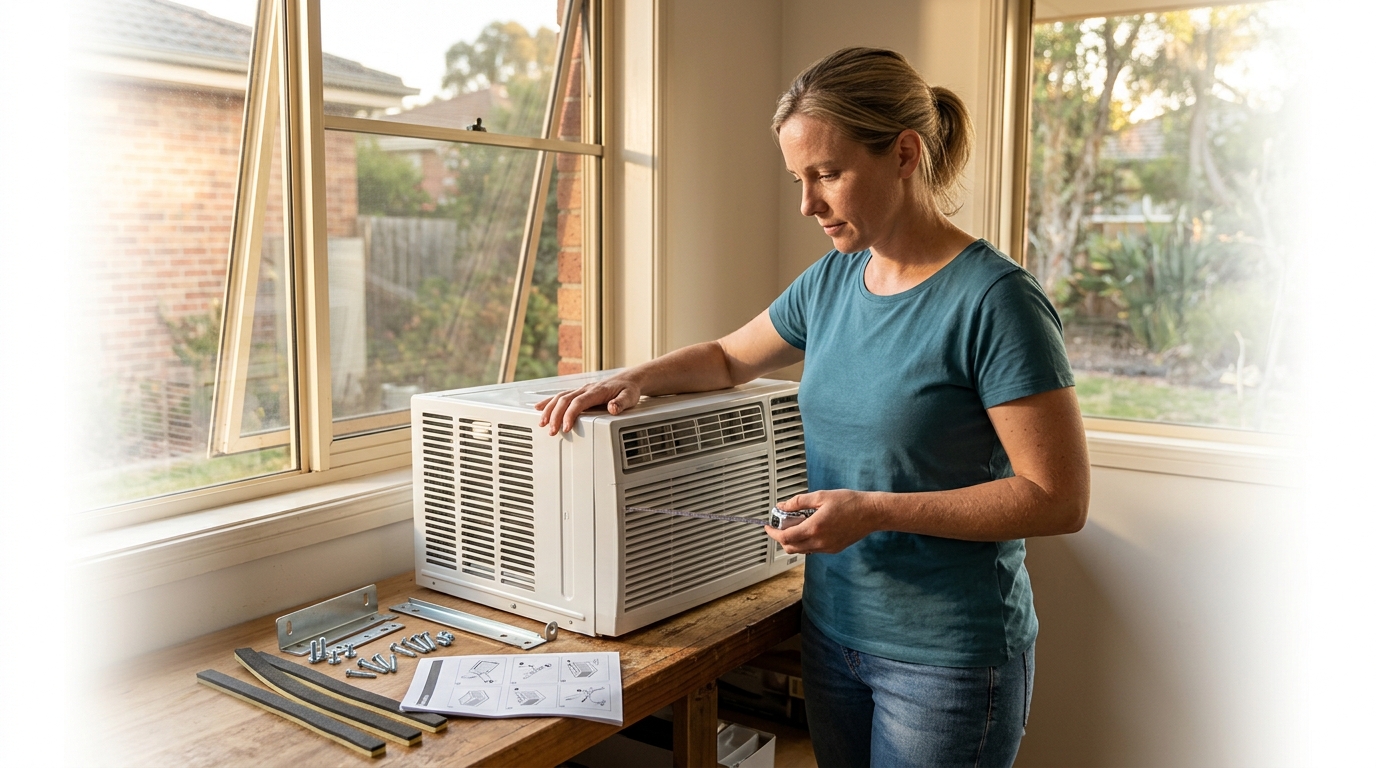
Once you have confirmed the window type, measure the opening carefully. You need the width of the opening (from frame to frame) and the height from the sill to the bottom of the upper sash. Compare these figures against the unit's dimensions in the product specifications. Most window units also specify a minimum and maximum opening width, so check both ends of that range, not just the overall size.
Next, check the window sill itself. It needs to be deep enough to support the base of the unit and structurally sound enough to bear the weight. A typical 2.7kW to 3.9kW window unit weighs between 15kg and 25kg, and a 5.3kW unit can push past 30kg. If the sill feels soft, is rotting or is narrower than the unit's base depth, you will need to address that before installation.
Finally, check the proximity of a power outlet. Most Australian window units up to around 4kW run on a standard 240V/10A circuit, the same as a regular household power point. Units at 5kW and above, including the Gree Aoky GJH18AE at 5.3kW, often require a dedicated 15A circuit. If you are not certain what your nearest outlet can handle, consult a licensed electrician before purchasing. Electrical work in Australia must be carried out by a licensed professional, and running an undersized circuit is a fire risk.
How to Install a Window Air Conditioner Unit: Step-by-Step
Installing a window air conditioner unit in a standard double-hung window is a manageable DIY job for most homeowners. The process takes roughly one to two hours and requires only basic tools. Follow these steps in order and you will end up with a unit that is secure, well-sealed and ready to run. If your window type is anything other than double-hung, stop at step three and look into a custom bracket kit before proceeding.
Tools and Materials You Will Need
- Phillips head and flathead screwdrivers
- Spirit level
- Tape measure
- Drill with drill bits
- Weatherstrip foam tape
- L-bracket or sash lock bracket (often included with the unit)
- Safety gloves
Most window unit kits include the accordion side panels and standard mounting hardware. Check the box contents against the manual before you start so you are not hunting for a missing bracket halfway through the job.
- Gather your tools and read the manual. Lay everything out before you start. Confirm the unit's dimensions against your window measurements one final time. This is also the moment to check that the included hardware matches what the manual describes.
- Fit the accordion side panels to the unit. Slide the extendable accordion panels into the tracks on each side of the unit. Most panels click or slide into a channel without tools. Do not extend them yet; keep them retracted until the unit is in position.
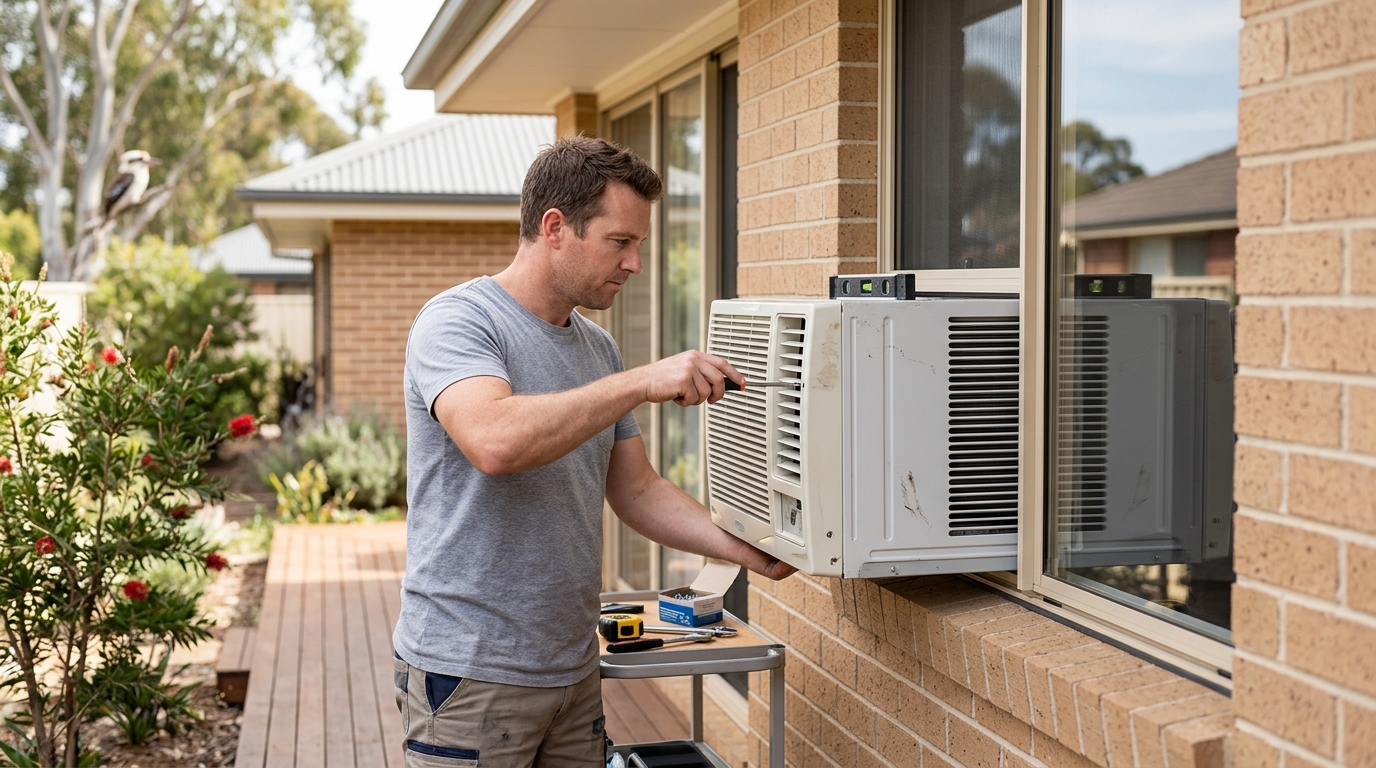
- Open the window and position the unit on the sill. Lift the unit into the opening and centre it in the frame. Put your safety gloves on before handling the unit as the casing edges can be sharp. The unit should sit level or with a very slight tilt toward the outside (around 1 to 2 degrees) so condensate drains away from the room. Use your spirit level to confirm this.
- Lower the window sash onto the unit's top rail. Bring the lower sash down until it rests firmly on the top rail of the unit. This locks the unit in place vertically and is the primary method of securing it in a double-hung window.
- Extend and screw the accordion panels flush against the frame. Pull each accordion panel outward until it meets the window frame on its side. Use your drill to drive the provided screws through the panel and into the frame. Check that there are no visible gaps between the panel and the frame on either side.
- Seal remaining gaps with weatherstrip foam tape. Run foam tape along any gaps between the top of the unit and the sash, and along the edges of the accordion panels where they meet the frame. This step keeps warm outside air and insects out of the room and also improves the unit's efficiency by preventing cool air from escaping.
- Secure the unit with the L-bracket or sash lock bracket. Fit the provided bracket to prevent the window sash from being pushed up and to stop the unit tipping outward. This is a safety-critical step, particularly in homes with children or in upper-storey rooms. Most kits include a sash lock bracket that screws into the lower sash and the upper sash channel.
- Plug in and test the unit. Connect the unit to the power outlet, set it to cooling mode and run it for five to 10 minutes. Check that cool air is coming from the front vents, that the unit is not vibrating excessively and that there are no unusual sounds. If the unit trips the circuit breaker, stop immediately and call a licensed electrician to assess the circuit capacity.
This process applies to standard double-hung windows. If your windows are casement, louvre or another non-standard type, the steps above will not apply directly and you will need a custom bracket kit or a wall sleeve installation instead. Renters in that situation may find that portable air conditioners are a simpler no-installation alternative that requires no modifications to the window at all.
A reminder on electrical work: in most Australian states and territories, any work involving wiring, circuit upgrades or new power point installation must be carried out by a licensed electrician. Plugging a unit into an existing outlet is fine as a DIY task, but if your outlet needs upgrading to 15A or you need a new circuit run, do not attempt that yourself.
When a Split System Makes More Sense
Window air conditioner units are a practical solution for renters, small rooms and situations where a quick, affordable fix is the priority. But they do have real limitations, and for many Australian homeowners a split system inverter unit is the smarter long-term choice. Understanding where window units fall short helps you make the right call before you spend money on either option.
The main drawbacks of window units are worth being honest about:
- They block natural light. A window unit fills the lower half of your window opening, which can make a room feel noticeably darker, particularly in south-facing rooms that already get limited sun.
- They are noisier than split systems. Because the compressor sits inside the same casing as the indoor unit, window units produce more audible noise in the room. A modern inverter split system keeps the compressor outside, so the indoor unit runs much more quietly.
- They are less energy-efficient. Modern inverter split systems adjust their compressor speed to match the room's cooling demand, which uses significantly less electricity than the fixed-speed compressors found in most window units. Over a full summer, that difference shows up on your power bill.
- They are not compatible with all window types. As covered earlier in this article, casement and louvre windows cannot accept a standard window unit without significant modification.
- They top out at around 30 sqm. The largest window units available, such as the Gree Aoky GJH18AE at 5.3kW, are rated for rooms up to approximately 30 sqm. For larger living areas, open-plan spaces or whole-home cooling, a window unit simply cannot do the job.
For permanent installations, rooms larger than 35 sqm or any situation where you want quiet, efficient, year-round climate control, a split system is the better investment. A 3.5kW Daikin LITE inverter split system (FTXF35WVMA) starts at $1,194, which is comparable to the upper end of the window unit range but delivers meaningfully better efficiency and quieter operation over its lifespan.
One important legal point: split system installation in Australia requires a licensed refrigeration mechanic who holds an ARCtick accreditation. This is not optional. Handling refrigerant without an ARCtick licence is illegal under Australian law, so unlike a window unit, a split system is never a DIY installation job. Factor the cost of professional installation into your budget when comparing the two options.
Browse our range of split system air conditioners if you are after a permanent, energy-efficient solution for a larger room or whole home.
Frequently Asked Questions
Can I install a window air conditioner myself in Australia?
Yes, in most cases. Fitting a window air conditioner unit into a double-hung window and plugging it into an existing power outlet is a legal DIY task in all Australian states and territories. The exception is any electrical work, such as upgrading a power point to 15A or running a new circuit, which must be carried out by a licensed electrician.
Do window air conditioners need to be vented outside?
Yes. A window air conditioner exhausts heat through its rear section, which sits outside the window opening. This is why the unit must be installed in an actual window or wall sleeve. Unlike portable air conditioners, window units do not use a separate exhaust hose, but they do require the rear of the unit to have clear access to outside air.
How long does it take to install a window air conditioner?
For a standard double-hung window, most homeowners complete the installation in one to two hours. This includes fitting the accordion side panels, seating the unit on the sill, lowering the sash, sealing gaps with weatherstrip tape and securing the safety bracket. Having a second person to help lift the unit makes the job considerably easier and safer.
What size window air conditioner do I need for a bedroom?
A typical Australian bedroom of 10 to 15 sqm needs a unit with around 2.5kW to 2.7kW of cooling capacity. A larger master bedroom of 15 to 20 sqm is better served by a 3.5kW to 3.9kW unit. These figures assume standard 2.4m ceilings and average insulation. Add one capacity tier if the room gets heavy afternoon sun or has poor ceiling insulation.
Can a window air conditioner cool an entire house?
No. A window unit is designed to cool a single room, not an entire home. Even the largest window units top out at around 5kW to 6kW, which is only sufficient for rooms up to about 30 sqm. For whole-home cooling, a ducted system or a multi-split system is the appropriate solution.
Are window air conditioners allowed in rental properties?
Generally yes, but you need your landlord's written permission before installing one. Most landlords will approve a window unit because it causes minimal structural change and can be removed when you leave. Patch any screw holes in the window frame when you move out and keep the original window hardware so you can restore the window to its original condition.
How much does it cost to run a window air conditioner in Australia?
Running costs depend on the unit's capacity, its energy star rating and your local electricity tariff. As a rough guide, a 2.7kW window unit running for eight hours a day at around 30 cents per kWh will cost approximately $2 to $3 per day. A higher-star-rated unit or a modern inverter split system will cost noticeably less to run over the same period.
Ready to Cool Your Room This Summer?
Installing a window air conditioner unit is a straightforward project when you approach it in the right order. Measure your window opening before you buy, match the unit's kW output to your room size, follow the step-by-step installation process and seal every gap properly with weatherstrip tape. And remember: any electrical work beyond plugging into an existing outlet must be done by a licensed electrician.
If you have worked through this guide and you know what you need, browse our window air conditioner range and get nationwide delivery across Australia. Not sure which capacity suits your space? Use our AC Size Calculator to get a personalised recommendation based on your room size, ceiling height and climate zone.
Need expert advice?
Our team can help you choose the right air conditioning system for your space.