
What Are the Different Types of Ducted Air Conditioners? (Including Ducted Packaged Units)
Understanding Ducted Air Conditioning Systems
A ducted air conditioner is a centralised climate control system that pushes conditioned air through a network of insulated ducts and ceiling or floor vents to cool or heat an entire home or building from a single unit. Unlike a wall-mounted split system that serves one room, a ducted setup gives you whole-home comfort with no visible indoor equipment beyond the vents themselves. The ducted air conditioners available today span several distinct configurations, each suited to different property types, climates and budgets.
The four main types you will encounter are ducted split systems, ducted packaged air conditioners, inverter ducted systems and reverse cycle ducted systems. Understanding how each one works will help you choose the right setup for your home or commercial build.
Key takeaways
- A ducted packaged air conditioner houses all components in one cabinet, ideal for commercial properties and homes without roof cavity space.
- Ducted split systems are the most practical choice for Australian residential homes, with lower installation costs and flexible placement options.
- Inverter technology and zone control significantly reduce energy consumption and improve comfort across all ducted system types.
The Main Types of Ducted Air Conditioning Systems
Ducted systems are not all built the same way. The configuration you choose affects where the equipment is installed, how efficiently it runs, and whether it can handle both heating and cooling. Here is a breakdown of the four primary types.
Ducted Split Systems
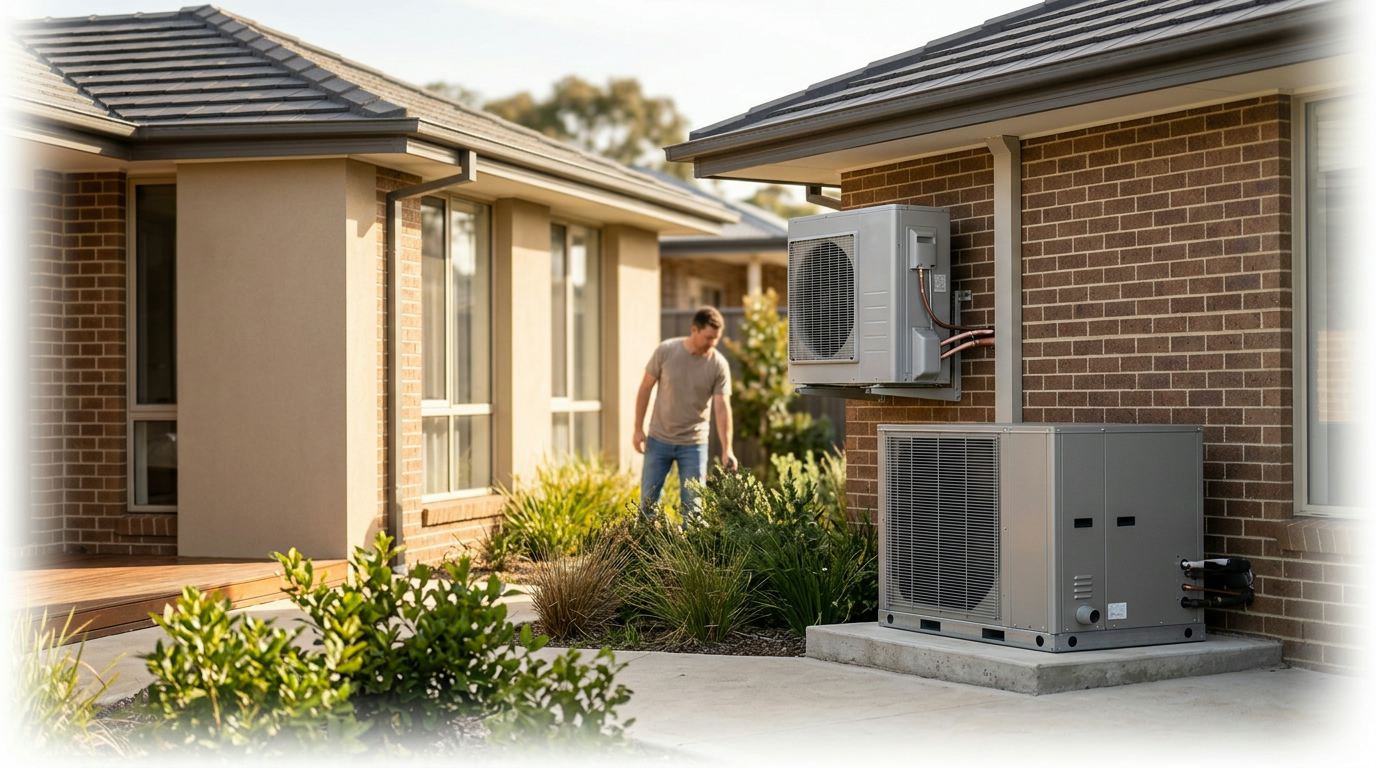
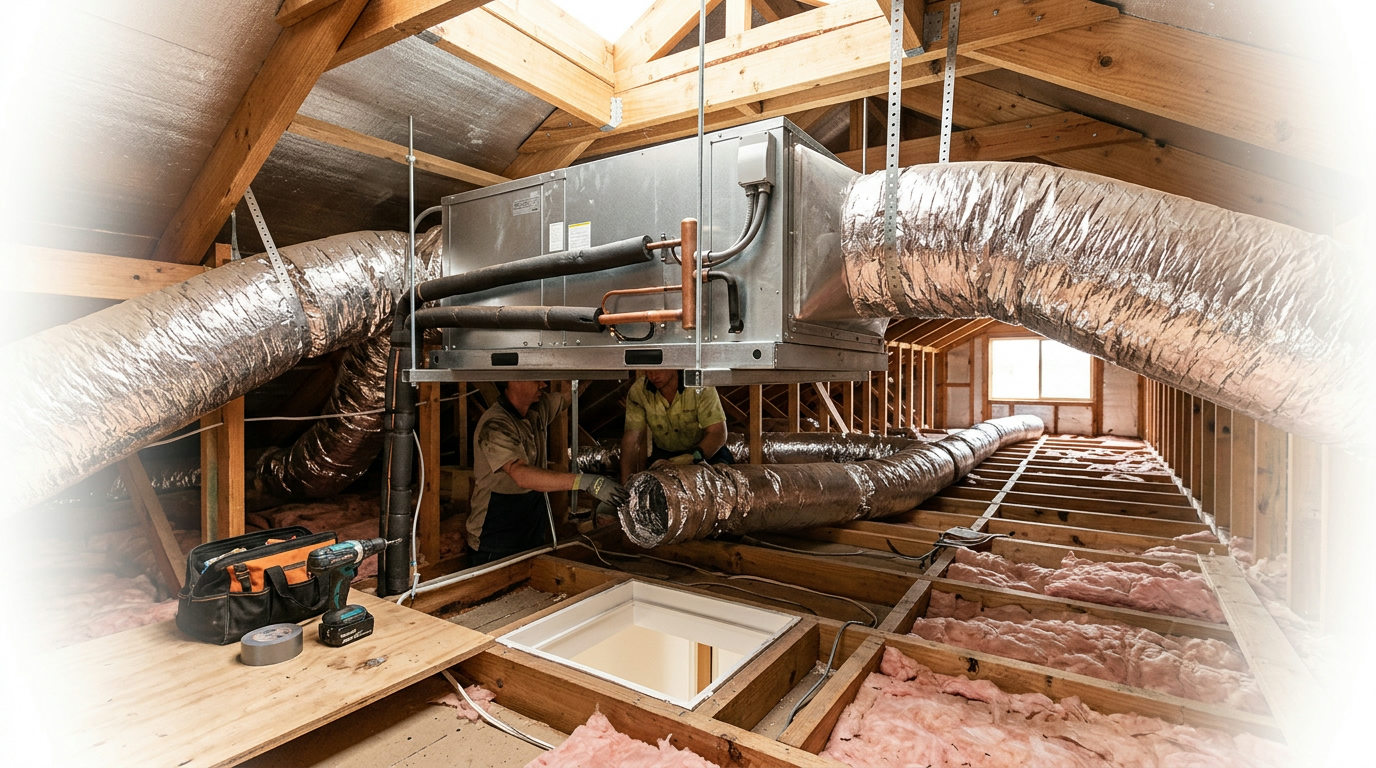
A ducted split system divides the work between two separate units: an indoor air handler installed in the roof cavity or under the floor, and an outdoor compressor unit mounted outside the building. The two units are connected by refrigerant lines and electrical cabling. This separation keeps the noisier mechanical components outside, which means quieter operation indoors.
This is the most common residential ducted configuration in Australia, and for good reason. The indoor unit can be tucked away out of sight, the outdoor unit can be positioned discreetly on the ground or a wall bracket, and the system scales well from mid-sized family homes up to larger properties. Most major brands offer ducted split systems across a wide capacity range, typically from around 7kW up to 20kW or more for residential use.
Daikin ducted systems are a popular choice in this category. The Daikin 10kW Inverter Ducted Air Conditioner FDYAN100, priced from $4,017, is a strong example of a quality residential ducted split system. It suits homes in the 100 to 150 square metre range and pairs with Daikin's zone control accessories for room-by-room management.
Ducted Packaged Air Conditioner Units
A ducted packaged air conditioner houses all of its components in a single self-contained cabinet. The compressor, condenser coil and air handler are all built into one unit, typically installed on the roof or on a concrete pad beside the building, with ductwork running from it directly into the space below.
Because everything is in one box, packaged units are generally easier and faster to service. Technicians only need to access one location rather than tracking down both an indoor and outdoor unit. They also free up indoor ceiling or floor space, which makes them a practical choice for buildings where roof cavity access is limited or where the indoor footprint is at a premium.
Packaged units are far more common in commercial and light-commercial settings, such as retail shops, offices and light industrial buildings, than in Australian residential homes. For a standard house, a ducted split system is usually the more cost-effective and practical option. However, if you are fitting out a larger property, a commercial tenancy or a building without a suitable roof cavity, a ducted packaged air conditioner is well worth considering.
Inverter Ducted Systems
Inverter technology refers to a variable-speed compressor that continuously adjusts its output to match the actual heating or cooling demand at any given moment. A traditional fixed-speed compressor runs at full power until the target temperature is reached, then shuts off completely, cycling on and off repeatedly throughout the day. An inverter compressor ramps up when you need it and slows down when you do not, rather than switching between full power and off.
The practical result is meaningful energy savings, particularly over a full season of use. Inverter systems also maintain a more consistent room temperature because the compressor is always fine-tuning its output rather than letting the temperature drift between cycles. You get fewer hot and cold swings and quieter overall operation.
Virtually all modern ducted systems from major brands now use inverter technology as standard. If you are comparing products today, you would have to look quite hard to find a new residential ducted system without it. The real differences between models come down to efficiency ratings, capacity range and smart features rather than inverter versus non-inverter.
Reverse Cycle Ducted Systems
A reverse cycle ducted system provides both cooling in summer and heating in winter from the same unit. It works by reversing the direction of the refrigeration cycle. In cooling mode, it extracts heat from inside and expels it outdoors. In heating mode, it extracts heat energy from the outside air and transfers it indoors, even when temperatures are quite low.
This makes reverse cycle the most popular choice for Australian homeowners who want year-round climate control without installing a separate gas heater or hydronic system. A single ducted reverse cycle unit handles both seasons, which simplifies installation, reduces ongoing maintenance and typically lowers running costs compared to resistive electric heating.
Reverse cycle systems perform well across most Australian climate zones, including cooler southern regions, though performance can drop in very cold alpine conditions. For most homes in Sydney, Melbourne, Brisbane, Adelaide and Perth, a reverse cycle ducted system is the practical default.
The Mitsubishi Electric 10kW Inverter Ducted Air Conditioner PEA-M100HAA, priced from $4,274, is a strong reverse cycle ducted option for mid-to-large homes. It combines reliable heating and cooling performance with Mitsubishi Electric's reputation for long-term durability and is compatible with zone control for added flexibility.
Ducted Packaged Air Conditioner vs. Ducted Split System: Which Is Right for You?
The choice between a ducted packaged air conditioner and a ducted split system comes down to your property type, available installation space and budget. Packaged units house all components in one cabinet, typically on the roof or a ground pad, while split systems divide the work between an indoor air handler and a separate outdoor unit. For most Australian homes, a ducted split system is the practical default, but packaged units have clear advantages in specific situations.
| System Type | Component Layout | Typical Application | Installation Complexity | Maintenance Access | Price Range (AUD) |
|---|---|---|---|---|---|
| Ducted Packaged Unit | All-in-one cabinet (compressor, condenser and air handler combined) | Commercial buildings, retail, offices, properties without roof cavity space | Moderate. Single location install, but rooftop work adds complexity | High. All components in one accessible location | $6,000 to $20,000+ installed |
| Ducted Split System | Separate indoor air handler and outdoor compressor unit | Residential homes, light commercial, properties with roof cavity access | Moderate. Two unit locations require refrigerant line runs between them | Moderate. Indoor and outdoor units must be accessed separately | $4,000 to $15,000+ installed |
A ducted packaged unit makes the most sense for commercial builds, rooftop installations and any property where there is no usable roof cavity for an indoor air handler. Because the entire system sits in one place, servicing is straightforward and there is no need to run refrigerant lines between two separate locations. Retail shops, offices and light industrial buildings are the most common applications in Australia.
For the vast majority of Australian residential homes, a ducted split system is the better fit. The indoor unit tucks neatly into the roof cavity, the outdoor unit sits on the ground or a wall bracket, and the overall installed cost is generally lower than a comparable packaged unit. Mitsubishi Electric ducted systems are a strong choice in this category, with a reputation for reliability and a wide capacity range that suits everything from three-bedroom homes to larger family properties.
Zone Control, WiFi and Other Features to Look For
Beyond the basic system type, the features built into a ducted air conditioner have a significant impact on comfort, running costs and day-to-day convenience. When getting quotes, ask specifically about zone control, WiFi connectivity and inverter efficiency ratings. These three factors will often make a bigger difference to your long-term satisfaction than the brand name alone.
Zone Control
Zone control lets you divide your home into separate areas and independently set the temperature in each one. Bedrooms can be switched off during the day while the living areas stay cool, and you can bring the bedrooms back on before bed without conditioning the whole house. In a well-zoned home, this can meaningfully reduce energy consumption compared to running the system at full capacity across every room at once. Most quality ducted systems support between two and eight zones, with motorised dampers in the ductwork controlling airflow to each area.
WiFi Connectivity and Smart Home Integration
WiFi-enabled ducted systems let you control your air conditioner from a smartphone app, whether you are on the couch or on the way home from work. You can set schedules, adjust temperatures remotely and monitor energy usage without touching the wall controller. Some systems also integrate with Google Home, Amazon Alexa or Apple HomeKit for voice control. If smart home compatibility matters to you, confirm which platforms a system supports before you commit, as not all brands offer the same level of integration.
Inverter Efficiency and Star Ratings
Australia's energy star rating scheme gives ducted systems a rating for both cooling and heating efficiency. More stars means lower running costs over the life of the system. Inverter compressors are the foundation of high star ratings because they avoid the energy waste of constant on-off cycling. The Daikin 14kW Inverter Ducted Air Conditioner FDYAN140, priced from $5,275, is a practical example of a feature-rich inverter ducted system with zone-control compatibility. It suits larger homes and is worth considering if you want a system that balances capacity, efficiency and smart features in one package. When comparing quotes, ask for the energy star rating on both the cooling and heating cycles, not just one or the other.
Ready to Choose Your Ducted System? Here's What to Do Next
Ducted air conditioners come in several configurations, but the choice for most Australian homeowners comes down to a ducted split system for residential use or a ducted packaged unit for commercial and light-commercial properties. Before you request quotes, take stock of your home's size, your local climate zone, your budget and whether zone control is a priority for your household.
A few practical steps will help you move forward with confidence. First, measure your floor area and note how many rooms you want to condition. Second, decide whether you need heating as well as cooling, since a reverse cycle system covers both. Third, check whether your roof cavity has enough clearance for an indoor air handler, as this affects which system type suits your property.
Once you have those basics sorted, you can browse our full range of ducted air conditioners to compare brands, capacities and price points in one place.
Frequently Asked Questions
What is a packaged air conditioner unit?
A packaged air conditioner is a self-contained unit that houses the compressor, condenser and evaporator all within a single cabinet, typically installed on a rooftop or beside a building. This differs from a split system, where the components are separated across indoor and outdoor units. Packaged units are common in commercial and light-commercial applications across Australia.
What is cheaper to run, a ducted or split system?
Split systems are generally cheaper to run for single rooms or small areas because they only condition the space in use. Ducted systems cost more to run overall, but become more cost-effective when conditioning large or whole-home areas, particularly with zone control that lets you switch off unused rooms. Inverter technology in both system types significantly reduces running costs regardless of which you choose.
What are the disadvantages of ducted air conditioning?
The main disadvantages of ducted air conditioning are higher upfront purchase and installation costs compared to split systems, and the need for adequate roof cavity or underfloor space to run ductwork. Running costs can also be higher if you are conditioning the whole home at once. Zone control helps offset the running cost disadvantage, but the complexity of ductwork installation and ongoing maintenance remains a consideration.
What is the $5,000 rule for air conditioners?
The '$5,000 rule' is a general industry guideline used to decide whether to repair or replace an ageing air conditioner. Multiply the unit's age in years by the estimated repair cost, and if the result exceeds $5,000, replacement is usually the more economical choice. This is a rule of thumb only, and a qualified technician should always assess the specific situation before you make a final decision.
Need expert advice?
Our team can help you choose the right air conditioning system for your space.