
Window Air Conditioner Installation: What You Need to Know Before You Buy
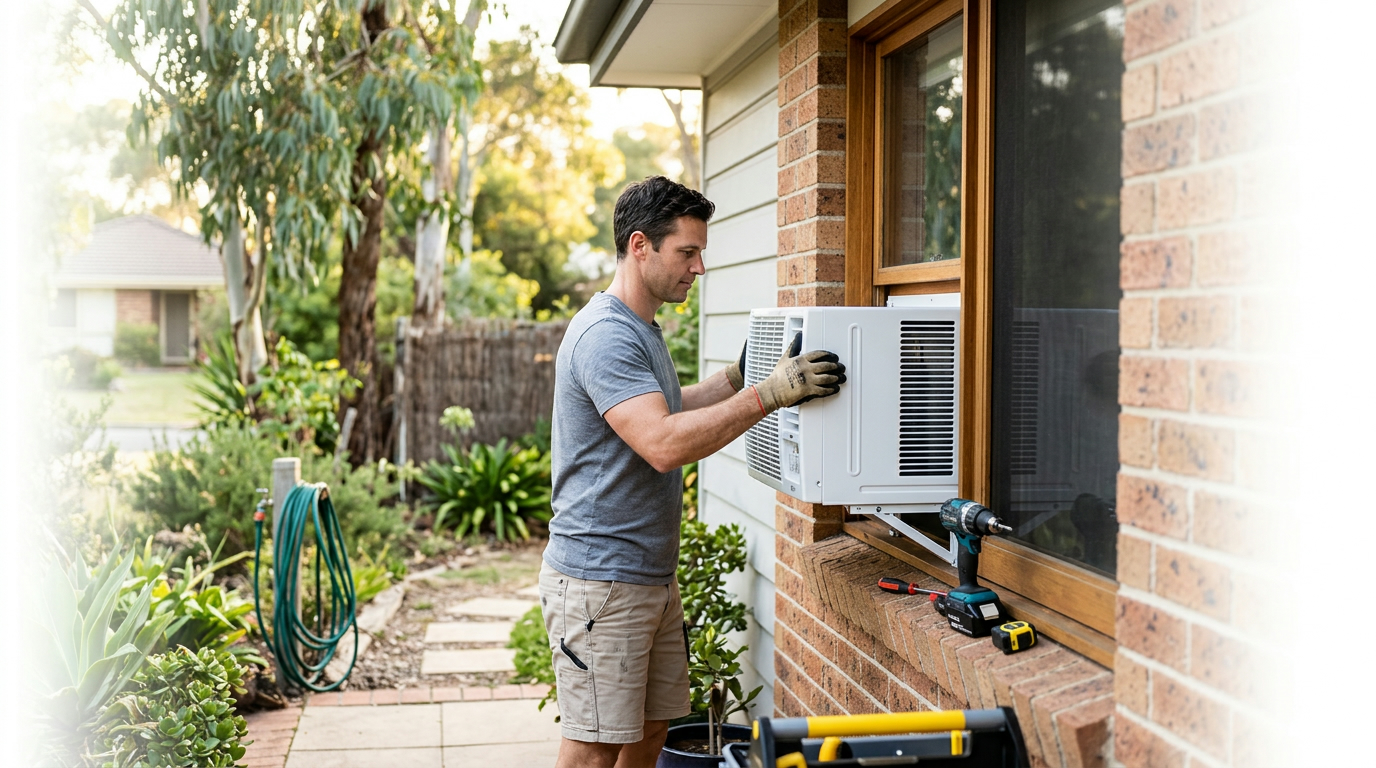
Window Air Conditioner Installation: What to Expect
Window air conditioners are often seen as the budget-friendly, no-fuss solution to cooling a room, and in many cases they are. But window air conditioner installation comes with real requirements that catch buyers off guard, from wall penetrations and electrical considerations to council rules and warranty conditions. This guide covers everything you need to know before you buy: how installation actually works, what it costs, when to call a professional, and how window units stack up against split systems.
Key takeaways
- Window air conditioner installation requires a licensed tradesperson for wall penetration work in most Australian states.
- Total installed cost typically ranges from $900 to $1,900 depending on wall type and electrical requirements.
- Window units suit short-term rentals and single-room cooling, while split systems offer better long-term efficiency.
How Window Air Conditioner Installation Actually Works
Installing a window or wall box air conditioner involves more than sliding a unit into a gap and plugging it in. In Australia, the vast majority of these units are installed as wall-sleeve installations, where a hole is cut through an external wall and a metal sleeve is fitted to house the unit. True window-mounted installs, which sit in a sliding sash window frame, are far less common here because most Australian homes use casement or louvre windows rather than the double-hung sash style common in North America.
Understanding which installation type suits your home is the first decision to make. Wall-sleeve installs are permanent, require structural work and are best suited to brick veneer, weatherboard or clad homes. True window mounts are simpler but depend entirely on having a compatible window type.
Here is how a standard wall-sleeve installation works, step by step:
- Measure the opening. Check the unit's required sleeve dimensions against your wall thickness and the available external wall space. Most box units specify a minimum and maximum wall depth, typically between 70mm and 300mm. Units like the Gree Aoky 2.7kW (GJH09AK, $767) and the 3.9kW model (GJH12AG, $905) have specific sleeve requirements listed in their installation manuals, so confirm these before ordering.
- Prepare the sleeve or frame. A licensed tradesperson cuts the opening in the external wall and installs the metal sleeve. The sleeve must be level and properly supported to carry the weight of the unit.
- Mount the unit. The air conditioner slides into the sleeve and is secured with the provided brackets or screws. Larger units like the Gree Aoky 5.3kW (GJH18AE, $1,152) are heavier and typically require two people to lift safely into position.
- Seal all gaps. Foam strips, weather seals and external flashings are fitted around the sleeve to prevent water ingress, draughts and pest entry. This step is critical for energy efficiency and weatherproofing.
- Connect to power. If the unit runs on a standard 10A plug and an existing GPO is nearby, you can plug it in directly. If a new circuit or a dedicated outlet is needed, a licensed electrician must do the work.
Do You Need a Licensed Installer?
For most wall-sleeve installations in Australia, yes. Cutting through an external wall is structural work and in most states and territories it requires a licensed builder, carpenter or registered handyperson depending on the scope. This is not a job for a weekend DIY project, and attempting it without the right licence can void your product warranty and create issues with home insurance claims down the track.
Electrical work is a separate consideration. If your new unit plugs into an existing 10A general purpose outlet (GPO) and no new wiring is needed, you can handle that connection yourself. But if the installation requires a new circuit, a dedicated outlet, a higher-amperage connection or any wiring work at all, a licensed electrician must carry it out. This applies in every Australian state and territory without exception.
The practical advice: budget for a licensed installer from the start. Most suppliers and installers can handle both the wall penetration and electrical connection in a single visit, which keeps costs down and ensures the job is done to code.
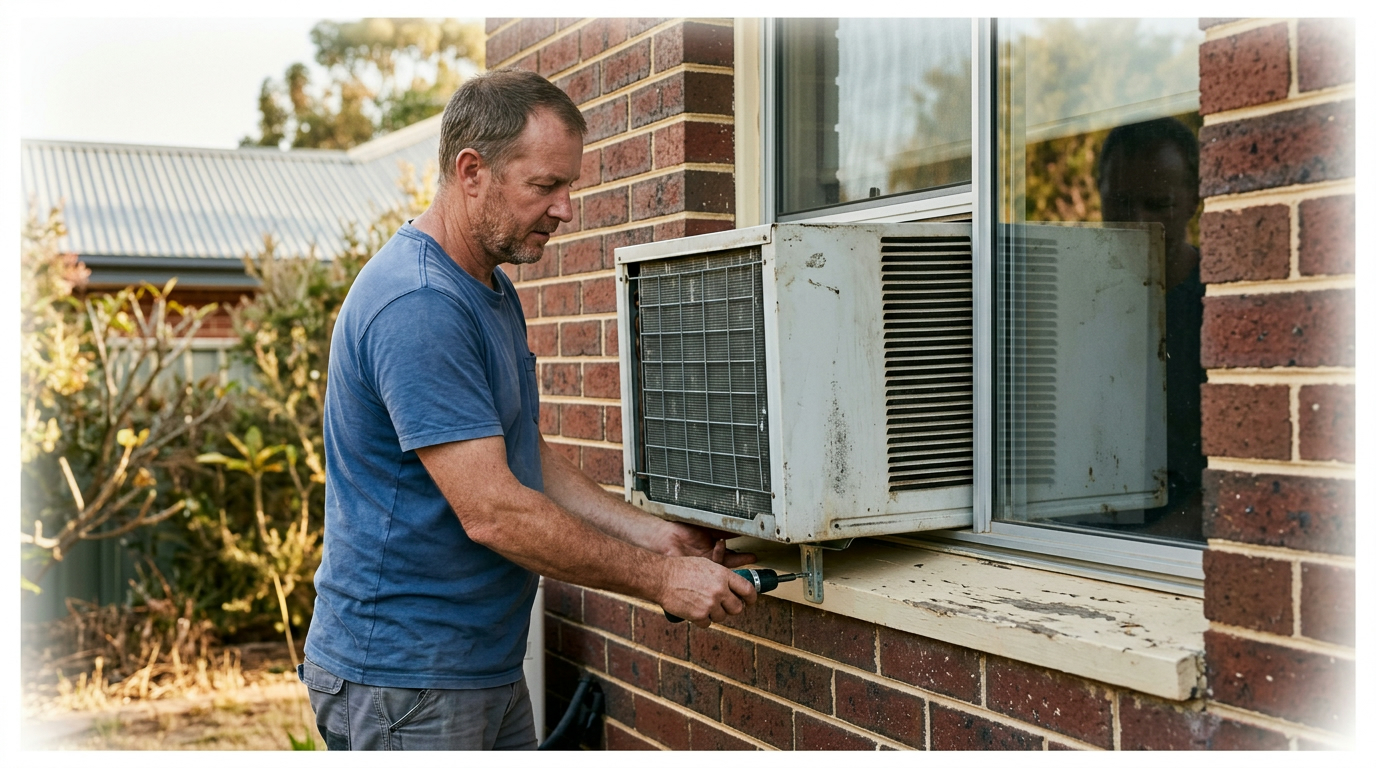
Installation Costs: Window Units vs Split Systems
Window and wall box air conditioners cost less upfront than split systems, but the total installed price is closer than most buyers expect. In Australia in 2026, a typical residential window or wall unit sits between $700 and $1,300 for the unit itself, with installation labour adding $200 to $600 on top depending on your wall type. A brick wall requires a core drill and more labour time, which pushes costs toward the higher end. Timber frame or weatherboard walls are quicker to cut and generally cheaper to work with.
Electrical upgrades are a separate cost that many buyers overlook. If your installation point already has a suitable 10A GPO nearby, no electrical work is needed. But if a dedicated circuit or a higher-amperage outlet is required, budget an additional $150 to $400 for a licensed electrician.
Compare that against a split system air conditioners installation, where the unit and professional installation together typically land between $1,500 and $3,500 all-in for a standard residential job. The gap narrows considerably once you factor in wall penetration labour and any electrical work on the window unit side.
| System Type | Unit Cost (AUD) | Installation Cost (AUD) | Total Estimated Cost (AUD) | Requires Licensed Installer |
|---|---|---|---|---|
| Window / Wall Box Unit (timber frame wall) | $700 to $1,300 | $200 to $400 | $900 to $1,700 | Yes (wall and electrical work) |
| Window / Wall Box Unit (brick wall) | $700 to $1,300 | $400 to $600 | $1,100 to $1,900 | Yes (wall and electrical work) |
| Split System (standard residential) | $800 to $2,200 | $600 to $1,300 | $1,500 to $3,500 | Yes (refrigerant and electrical work) |
The upfront saving on a window unit is real, but it comes with a trade-off on running costs. Most window and wall box units carry lower energy star ratings than comparable split systems, which means higher electricity bills over time. For a room you use daily, that difference adds up across a full cooling season.
Key Things to Check Before You Buy a Window Unit
Before you order a window or wall box air conditioner, there are five practical checks that can save you from a costly mistake. Getting the sizing wrong, misjudging your wall type or overlooking strata rules are among the most common problems buyers run into, and all of them are easy to avoid with a bit of preparation.
- Measure the wall opening carefully. Match the unit's required sleeve dimensions to your available wall space before you buy. Check both the external opening size and your wall thickness. Most units specify a minimum and maximum wall depth, and ordering the wrong size means the sleeve will not fit correctly.
- Check your wall material. Brick walls require a core drill to cut the opening, which takes more time and costs more in labour. Timber frame and weatherboard walls are faster and cheaper to work with. Know what you have before getting quotes.
- Confirm your power supply. Most window units up to 3.9kW run on a standard 10A GPO. Larger units may require a 15A or 20A dedicated circuit. Check the unit's electrical specifications before assuming you can plug it straight in.
- Check strata and rental rules. Many body corporates and landlords restrict or prohibit modifications to external walls. Get written approval before you buy anything. Cutting a hole in a wall without permission can result in you being required to make good the wall at your own expense.
- Consider the noise level. Window and wall box units are generally louder than split systems. Indoor noise levels for box units typically sit between 45 and 55 dB, compared to 19 to 32 dB for a quality split system. If the unit is going into a bedroom or study, that difference matters.
Sizing Your Window Unit for the Room
Matching the right kilowatt capacity to your room size is the single most important decision you will make. An undersized unit runs constantly without ever reaching your target temperature, while an oversized unit short-cycles, wastes energy and does a poor job of dehumidifying the air.
Use this table as a starting point, keeping in mind that ceiling height, insulation quality, sun exposure and climate zone all affect the final figure:
| Room Size | Recommended Capacity | Example Unit | Price (AUD) |
|---|---|---|---|
| Up to 20 sqm | 2.5 to 3.5kW | Gree Aoky 2.7kW (GJH09AK) | $767 |
| 20 to 35 sqm | 3.5 to 5kW | Gree Aoky 3.9kW (GJH12AG) | $905 |
| 35 to 50 sqm | 5 to 6kW | Gree Aoky 5.3kW (GJH18AE) | $1,152 |
The Gree Aoky range covers the most common residential room sizes and all three models are reverse cycle, meaning they handle both heating and cooling. If you are in a north-facing room in Queensland or a poorly insulated space in Western Australia, add around 10 to 15 per cent to your estimated capacity requirement to account for the extra heat load.
Is a Window Unit the Right Choice, or Should You Consider a Split System?
Window and wall box air conditioners suit specific situations well, but they are not the right fit for every home or buyer. The honest answer is that your tenure in the property, your budget, your wall type and how much you care about noise and energy efficiency will all point you toward one option or the other. Here is a straightforward breakdown to help you decide.
| Your Situation | Better Option | Why |
|---|---|---|
| Renting with landlord approval, short-term stay | Window / wall box unit | Lower upfront cost, easier to justify for a temporary install |
| Tight budget, single room to cool | Window / wall box unit | Units like the Gree Aoky 2.7kW at $767 are among the most affordable reverse cycle options available |
| No suitable external wall space for a split system | Window / wall box unit | Box units need only a single wall penetration with no outdoor unit placement required |
| Homeowner wanting a long-term solution | Split system | Better energy efficiency, lower running costs and longer service life |
| Bedroom, study or noise-sensitive room | Split system | Indoor noise levels of 19 to 32 dB versus 45 to 55 dB for most box units |
| Aesthetics matter, or you want Wi-Fi control | Split system | Slim wall-mounted heads and app control are standard on most modern split systems |
If you are renting and cannot get approval for any wall penetration at all, portable air conditioners are worth considering as a no-installation alternative. The Rinnai 2.6kW Portable (RPC26MC, $689) is a cooling-only unit that requires no wall work and simply vents through a window kit. The trade-off is that portables are less efficient, noisier and take up floor space, so they work best as a stopgap rather than a permanent solution.
If you have decided a window or wall unit is the right fit, browse our full range of window air conditioners to compare models, capacities and pricing. If a split system is looking more appealing after reading this guide, our split system range covers everything from compact 2kW bedroom units through to high-capacity multi-zone setups.
Frequently Asked Questions
Can I install a window air conditioner myself in Australia?
You can handle the final connection yourself if the unit plugs into an existing 10A GPO and no new wiring is needed. However, cutting the wall opening and fitting the sleeve is structural work that requires a licensed tradesperson in most states and territories. Attempting the wall work without the right licence can void your warranty and create problems with home insurance.
Do window air conditioners need to be vented outside?
Yes. Window and wall box air conditioners expel heat through the rear of the unit, which must face the outside. This is why they require a wall or window opening rather than sitting freely in a room like a fan. There is no way to operate a window unit effectively without an external vent path.
How much does it cost to install a window air conditioner in Australia?
Installation labour typically costs between $200 and $600 depending on your wall type. Timber frame walls sit at the lower end, while brick walls requiring a core drill push costs higher. If electrical work is also needed, budget an additional $150 to $400 for a licensed electrician on top of the wall penetration cost.
What size window air conditioner do I need for a bedroom?
A standard Australian bedroom of 10 to 20 square metres generally needs a unit in the 2.5 to 3.5kW range. Rooms with poor insulation, high ceilings or significant north or west sun exposure may need slightly more capacity. Always check the manufacturer's sizing guide and factor in your local climate zone before deciding.
Are window air conditioners less efficient than split systems?
Generally, yes. Most window and wall box units carry lower energy star ratings than comparable split systems, which translates to higher electricity costs over a full cooling season. For a room used daily over many years, the running cost difference can outweigh the lower upfront price of a window unit. Split systems are the better long-term investment for efficiency.
Can a landlord refuse a window air conditioner installation?
Yes. Because wall-sleeve installations involve cutting through an external wall, most landlords and body corporates treat them as structural modifications requiring written approval. Some landlords will agree with conditions, such as requiring you to make good the wall when you leave. Always get approval in writing before purchasing the unit or booking an installer.
Ready to Cool Your Space? Here's What to Do Next
Three things matter most before you commit to a window or wall box air conditioner: confirm your wall type and power supply before you buy, budget for licensed installation labour on top of the unit price, and honestly weigh up whether a split system offers better long-term value for your situation. Get those three right and you will avoid the most common and costly mistakes buyers make.
If a window unit is the right fit, the Gree Aoky range covers the most common room sizes, from the 2.7kW model at $767 through to the 5.3kW option at $1,152, all with reverse cycle heating and cooling included. If the total installed cost of a window unit is starting to look close to split system territory, that comparison is worth running before you decide.
Ready to find the right unit? Browse our window air conditioner range to compare models, capacities and current pricing.
Need expert advice?
Our team can help you choose the right air conditioning system for your space.